
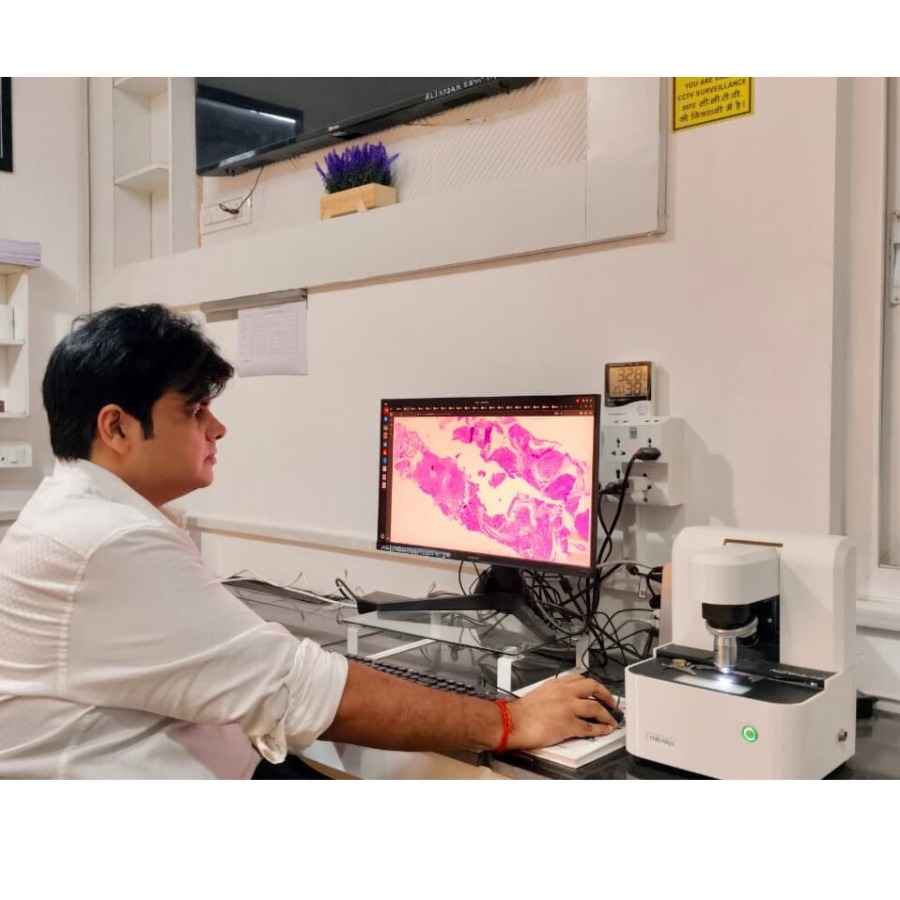
In the bustling city of Varanasi, where history and modern medicine coexist, well known pathologist Dr. Ankur Singh has been quietly shaping the future of diagnostics. As the owner of a private pathology laboratory serving both hospitals and referral cases, his days are filled with intricate slides, delicate specimens, and the constant pursuit of accuracy. He is an MBBS, DNB (Pathology), and serves as the Laboratory Director at Ankuram Labs in Varanasi, Uttar Pradesh.
For years, Dr. Ankur harbored a fascination for whole slide imaging (WSI). The idea of digitizing an entire slide viewing it in detail from anywhere, sharing it instantly with peers wasn’t just appealing, it felt inevitable. But like many pathologists, he knew that most WSI systems came with a steep price and a workflow overhaul he wasn’t ready for.
That changed when he discovered Micalys. Having already used a Cilika microscope from Medprime, he trusted the brand’s quality. The promise of a cost-effective, intuitive digital pathology solution was too good to pass up.
“Digital pathology is the future,” he says. “Micalys lets me be part of that future without disrupting my present.”
 A New Way of Seeing
In his practice, a significant part of Dr. Ankur’s work involves skin biopsies of small, carefully excised pieces of tissue collected by dermatologists or surgeons to investigate conditions ranging from chronic rashes to suspected skin cancers. These samples arrive preserved in formalin, each one representing a patient’s unanswered question. This type of whole tissue visualization is not possible in a conventional light microscopy. Micalys gives a wealth of diagnostic insights from even small biopsies, greatly aiding in arriving at the correct diagnosis.
Equally critical are the bone marrow biopsies he performs for patients battling blood-related disorders, including leukemia and lymphoma. These involve extracting a small core of bone and marrow, usually from the pelvic bone, to assess cell morphology, blood cell production, and disease progression. For each case, he may need to compare pre-treatment and post-treatment slides, carefully hunting for subtle cellular changes that could signal remission or relapse.
According to the Indian Council of Medical Research (ICMR), India sees an estimated 70,000–80,000 new cases of skin cancer annually and over 40,000 new leukemia cases each that underscore the importance of accurate and timely diagnostics.
With Micalys, Dr. Ankur’s work in both areas became significantly more efficient.
The ability to scan the entire slide and view it at low power meant that skin biopsies could be evaluated in their entirety at a glance, without the need to tediously move from field to field. Subtle architectural patterns crucial for differentiating between benign and malignant lesions were now instantly visible. The exceptional image quality further enhanced diagnostic confidence, bringing out even the most delicate cellular features with clarity. This level of detail allowed complex cases to be assessed with greater ease and precision.

For bone marrow biopsies, Micalys enabled side-by-side comparison of serial slides, making it easier to track therapeutic progress in leukemia patients. The high-resolution scans preserved every detail of marrow structure, allowing him to revisit and re-analyze cases without re-cutting slides.
Technology that Fits, Not Forces
Unlike other whole slide imaging systems demanding special low-magnification lenses and complex setups, Micalys fit neatly into his existing workflow. The software interface was intuitive, the transition seamless.
Key features such as morphometry tools for measuring tumor invasion depth, secure digital storage, and sharing capabilities meant that his practice wasn’t just keeping pace with modern pathology it was leading.
Looking Ahead

Dr. Ankur sees Micalys as more than just a tool; it’s a bridge to the next era of diagnostics. With its affordability, precision, and potential for AI integration, he believes it can democratize digital pathology for labs that once thought it out of reach.
“If you want to be future-ready without losing your present efficiency, Micalys is the way forward,” he concludes.
Micalys didn’t just upgrade his microscope it expanded his approach to diagnostics.